
Scandinavian Credit Fund I AB (publ) reports a NAV price for September of 36.98, which is a decrease of 3.45 % compared to the previous month. The fund's assets under management at the end of the month amounted to SEK 998 million.
The month's NAV development is primarily explained by declines in the fund's direct and indirect exposure to shares that are admitted to trading on a regulated market or MTF platform. The absolute largest negative effect came from assets linked to VIMAB Group AB, while the rest of the portfolio overall had only marginal valuation changes.
The fund's directly owned portfolio is distributed across asset classes as shown below at the end of the month.

The Fund's exposure to shares traded on the marketplace amounted to approximately SEK 225 million on 30 September 2026, corresponding to approximately 23 percent of managed assets, calculated on the number of shares at closing price. The exposure, which is both direct and indirect, is distributed across five companies: Episurf Medical AB, Fable Media Group AB, Ortelius International AB, OXE Marine AB and VIMAB Group AB. The amount does not constitute the Fund's carrying amount for the financial instruments through which the exposure is held, nor is it an assessment of the amount that could be realized upon sale. The Fund's carrying amounts and provisions are determined in accordance with the accounting principles applied by the Fund.
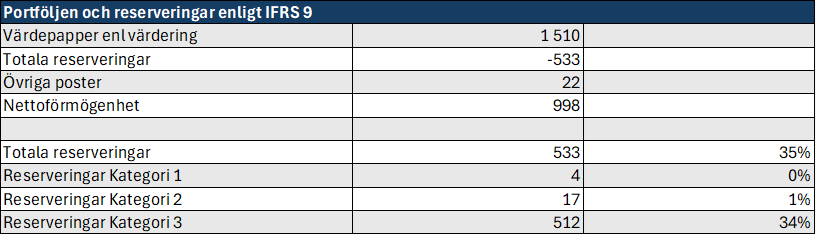
Provisions for expected credit losses according to IFRS 9 decreased during the month from SEK 538 million to SEK 533 million. The decrease is mainly attributable to the fact that a receivable from Blue Cover ApS of DKK 3.5 million has been written off as an established credit loss. That credit loss was absorbed by an existing provision and therefore did not affect the NAV for the month. For other commitments, the changes in provisions were marginal overall. Provisions for credit losses are made in accordance with applicable accounting rules and are based on an assessment of expected credit losses at the reporting date. However, a final established credit loss can only be determined when an individual case is legally closed.
According to the model that the Fund applies for provisions for credit losses on loans, the provision per category amounts to the following.
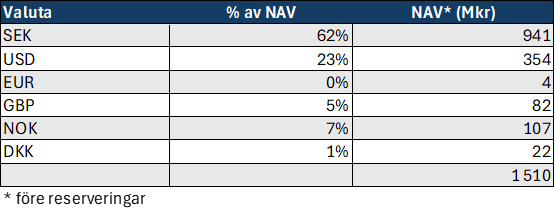
The Swedish krona weakened during the month against all currencies in the portfolio. The largest movement was noted against the US dollar, which strengthened by 4.6 percent. This increased the reported value in kronor of the fund's assets whose value is stated in dollars. Holdings in British pounds, euros, Danish kronor and Norwegian kronor also increased in value calculated in Swedish kronor. For several of the fund's assets, exchange rate changes affect both the asset's gross reported value and the provision for expected credit losses. For fully reserved assets, these effects cancel each other out and therefore do not affect the fund's NAV. For partially reserved assets, the NAV is affected only by the unreserved part of the exposure.
However, currency effects should be interpreted with caution. For several of the Fund's foreign holdings, the actual recoverable amount is determined primarily by the development of the underlying business and the possibilities for recovery. The fact that the assets are valued in a certain currency does not necessarily mean that the underlying business's recoverable amount has the same currency sensitivity.
Loans and shares in the portfolio before reserves are distributed in underlying currencies as below.
The fund does not otherwise comment on individual holdings, ongoing sales processes or specific counterparties. The reasons are partly regulatory, as the fund's profit-sharing loans are admitted to trading on NGM's regulated market and are subject to the Market Abuse Regulation (MAR), and partly strategic. An open disclosure of the fund's position in ongoing negotiations could directly counteract the unitholders' common interest in maximizing recovered capital. For the same reason, this letter describes the portfolio's development at an overall level rather than individual assets.
No significant transactions were carried out during the month.
About refunds
The Fund seeks to repay capital to investors when possible without limiting the Manager's ability to act in the best interests of investors. In addition to the Fund's need to maintain a liquidity buffer, each repayment incurs costs. The Manager therefore continuously assesses whether the available liquidity in addition to the buffer is sufficient for a repayment to be economically justified and provide meaningful value to investors. The Manager does not commit to any predetermined timing for such repayments.
Changed information provision
The fund has previously communicated that the document from 2024 on process and management during the liquidation will be updated. The work on the update has been postponed due to a change in management at the fund company Finserve Nordic. Before the document is completed, the forms for the future work need to be decided. This work also needs to take into account how applicable accounting standards and valuation principles and policies affect the fund's scope for action and information provision. At the same time, the information provision needs to be designed taking into account that the fund's profit-sharing loans are admitted to trading on NGM's regulated market and are covered by the Market Abuse Regulation (MAR). It also needs to balance investors' needs for relevant information against the risk that information about individual counterparties, ongoing sales processes or negotiations gives counterparties insight into the fund's position and thereby impairs the opportunities to maximize the capital that can be recovered for the investor community.
Questions after the webinar
The Fund held a webinar on September 21, 2026. Many questions were received in connection with the webinar. The questions have been grouped thematically. Questions relating to the same topic have been merged and answered together. The headings are numbered so that the answers can refer to each other. Among the questions received are a number of questions that we are currently unable to answer. We ask that you return to these later.
Content
1. NAV, valuation and provisions
2. Repayments, schedule and payment
3. Portfolio, transparency and listed shares
4. Historical lending and collateral
5. Costs, liquidity and related parties
6. Rights, trade, distribution and reporting
1. NAV, valuation and provisions
1.1 How should advisors explain the development to their clients?
The fund's NAV is affected by several different factors that should be kept separate when explaining performance. Capital repayments reduce net assets and NAV directly, without changing the underlying value of the portfolio (see 2.2). Reported value changes, especially in market-traded shares, affect NAV from month to month (see 1.2 and 3.2). Provisions for expected credit losses are the manager's best estimate at each reporting date and not realised losses (see 1.3-1.5). Currency fluctuations affect NAV only through the unreserved part of the exposure (see 1.2). Management and liquidation costs reduce net assets.
In summary, the NAV price represents the manager's best assessment of the value of the fund's assets, taking into account the accounting principles.
1.2 The fund's value and performance in September
Answers the following questions:
- What is the fund's value today?
- Can the decline over the past month be mainly explained by listed equity exposure?
- How do previous currency statements relate to September's currency development?
As of September 30, 2026, the fund's net assets amounted to approximately SEK 998 million and the NAV price was 36.98. The decline is primarily explained by decreases in the fund's exposure to market-traded shares, while the rest of the portfolio as a whole had marginal valuation changes. See the introduction to the letter.
The weakening of the krona during the month increased the carrying amount in kronor of assets in foreign currency. For fully reserved assets, exchange rates do not affect NAV. For partially reserved assets, NAV is affected only by the unreserved portion.
1.3 How much of the loan loss provisions is considered to be final loss, and how much can be recovered?
The provisions for credit losses represent, at the reporting date, the manager's best estimate of expected credit losses in accordance with IFRS 9. They cannot be divided into a final and a recoverable part. A provision is a probability-weighted average of several possible outcomes and therefore does not normally correspond to any of the individual outcomes. No part of the provision is therefore final or recoverable in advance. A final, established credit loss can only be determined when an individual case is closed.
The assessment refers to the expected outcome, which is not the same as the most likely outcome. Example: A receivable amounts to SEK 10. The assessment is that SEK 8 is recovered with a 75% probability in three years and that nothing is recovered with a 25% probability. The expected recovery is then SEK 6 (8 x 0.75 + 0 x 0.25) in three years. The amount is discounted at the receivable's original effective interest rate, in the example 10% per year, which gives a value at the time of reporting of approximately SEK 4.50. The receivable is taken up to SEK 4.50 and the provision amounts to SEK 5.50. The most likely individual outcome is still that SEK 8 is recovered, which would correspond to a loss of only SEK 2.
If the expected recovery is still assessed to be SEK 6, the provision will gradually decrease due to discounting, as the recovery date approaches. The NAV will increase correspondingly. Just before recovery, the provision will amount to SEK 4. When the case is closed, the receivable will be written off against the provision. The writing off itself does not affect the NAV, only the difference between the actual outcome and the latest assessment does. If the outcome is the good, most likely one, SEK 8 will be recovered and the final loss will be SEK 2. The provision will then turn out to have been SEK 2 too high, and the difference will increase the NAV. If the outcome is the worse, the final loss will be SEK 10, i.e. SEK 6 more than reserved, and the NAV will decrease by that amount. Neither of the two outcomes corresponds to the original provision of SEK 5.50 nor to the provision just before recovery of SEK 4.
Theoretically, the entire provision can be recovered if the claim is paid in full, but that is not the assessment. The assessment is that the provision corresponds to the expected loss. In individual cases, the outcome will deviate from the provision in both directions, but if the assessments are well balanced, the deviations tend to even out at the portfolio level.
1.4 Why have provisions increased sharply since March 2026?
The increase in provisions occurred primarily in May 2026. At that time, provisions rose from SEK 295 million to SEK 530 million. As stated in the monthly letter for May, the increase was mainly due to two major commitments.
One commitment was already classified in category 3. New information led to a revaluation and a significantly higher provision for expected credit losses.
The second commitment was moved to category 3. This means that the entire expected credit loss is reserved for the remaining term of the commitment.
Provisions under IFRS 9 are reviewed at each reporting date. The assessment is based on the information available at that time about credit risk, expected recovery, collateral and the timing of recovery. Other relevant circumstances are also taken into account. New information may therefore lead to an increase or decrease in provisions. The increase reflects updated assessments. It does not in itself mean that credit losses have been realized.
1.5 What valuation principles and external controls are applied to remaining assets?
The fund's remaining assets are valued in accordance with the accounting and valuation guidelines that apply to Finserve Nordic's funds. According to the guidelines for the Credit Fund, the value of the investment portfolio shall be determined on objective grounds in accordance with generally accepted accounting principles. This means that the value of the assets is calculated after deduction of the liabilities and costs relating to the fund's operations. Financial instruments and listed securities are valued in accordance with generally accepted accounting principles with the support of external market data sources. Unlisted holdings are valued at fair value in accordance with market practice. Loan receivables are valued at amortized cost, taking into account provisions in accordance with IFRS 9.
The valuation and NAV determination are subject to internal control by the fund administration, manager, risk function and independent valuation function. The final valuation basis must be approved by the independent valuation function before it is used as the basis for the NAV determination. In addition, the fund's management and financial reporting are reviewed by an external auditor elected by the general meeting as part of the regular management audit and financial statement review. The fund's custodian also receives NAV reports, balance sheets, holding reports and risk reports according to the established process.
2. Repayments, schedule and payment
2.1 Next repayment and settlement schedule
Answers the following questions:
- When is the settlement complete and when can the next capital repayment take place? What criteria must be met?
- How much of today's NAV can be realized within 12, 24 or 36 months?
- Why has the previously stated timetable of up to two years been changed?
- Have previously communicated partial payments not been made, and what is the plan for terminating the fund?
See the section ”About repayments” above. No binding end date or predetermined payout date can be stated because several assets lack a liquid market or are dependent on sales processes, legal proceedings or developments in underlying businesses. A reliable accrual forecast cannot therefore be provided. The plan for the fund’s closure will be communicated later as mentioned under “Changed disclosure” above.
2.2 Repayments made and the effect on the NAV price
Answers the following questions:
- What capital repayments have been made so far?
- How do repayments affect the NAV price?
- How much of the NAV decline is due to capital repayments and how much is due to value changes?
Since the fund was closed for liquidation on May 26, 2023, four pro rata repayments to the investor community have been made totaling SEK 417 million:
| Time | Amount (SEK million) |
| July 2023 | 250 |
| December 2024 | 85 |
| August 2025 | 40 |
| December 2025 | 42 |
| Amount | 417 |
The nominal amount of the profit-sharing loan has been kept unchanged in previous pro rata repayments. Therefore, when capital leaves the fund, the net asset value and NAV price decrease immediately, even if the underlying value of the remaining portfolio is not changed by the repayment itself.
The capital repayments since the closure in May 2023 correspond to 15.4 in reduced NAV price. If the capital had instead remained in the fund, without affecting returns or costs, the NAV price as of September 30, 2026 would have been 52.4.
2.3 Proceeds from the property deal in Norrtälje and the approximately SEK 340 million
Answers the following questions:
- Is there capital for a new repayment after the property sales in Norrtälje?
- What is the forecast for the approximately SEK 340 million that was previously estimated to be realized in 2026? How much has been realized and how much remains?
- Did the fund receive approximately SEK 69.8 million in cash from the Episurf/property deal, and how has the money been used?
So far, no cash has come from the sale of the properties. The property companies have been exchanged for other assets.
Of the approximately SEK 340 million, approximately SEK 22 million has been realized to date. These assets were included with approximately SEK 27 million in the calculation of the SEK 340 million. The remaining assets, which were included with approximately SEK 313 million, were valued at approximately SEK 345 million as of September 30, 2026. The fact that the value is on par with the original amount is mainly due to the fact that the share that was included in the payment for the so-called Norrtälje properties has increased, while several other items have been devalued. However, the processes to realize the remaining amount are proceeding significantly slower than the assessment at the beginning of the year was based on.
2.4 Can shares, especially Episurf, be distributed as a dividend in kind to investors?
No, not under the conditions that apply today.
According to the general terms and conditions of Scandinavian Credit Fund I AB (publ), dated 4 October 2022, repayment shall be made in cash. This applies both when the loan matures (clause 4.2) and in the event of early repayment following termination at the fund's request (clause 4.15).
The information brochure, dated April 7, 2026, also states that the profit-sharing loans are repaid in Swedish kronor (section 1.2).
The terms therefore do not allow for repayment with assets other than cash. In order for shares to be transferred to investors, the terms must first be amended. However, the terms do not clearly state how such an amendment is to be implemented or whether investor consent is required. This must therefore be clarified before such a solution can be considered.
Repayment with other assets must also respect the rights of investors and the equality of profit-sharing loans. The distribution must be made on objective and proportional grounds. Rules are also needed for valuation, settlement, fractions and residual amounts.
Finally, the legal, tax and practical conditions must be investigated. This applies, among other things, to whether the transfer can be carried out through Euroclear and the account-keeping institutions' systems.
3. Portfolio, transparency and listed shares
3.1 What the portfolio consists of
Answers the following questions:
- How is the remaining portfolio distributed between different asset classes?
- What does the residual value consist of when listed and unlisted exposure is compared to net worth?
- Does the portfolio still consist mainly of regular loans with interest and amortization?
The distribution between asset types is shown in the first table above. It shows the reported values for directly owned shares, loans and bonds, preference shares, options and other net, and cash and cash equivalents.
The portfolio no longer consists primarily of ordinary loans with interest and amortization. It now includes several types of assets and exposures, including loans to bankrupt estates, restructured or defaulted bonds, listed and unlisted shares, and loans and shares in indirectly controlled companies.
The Fund's direct holdings in different asset classes do not always indicate which underlying assets or rights ultimately determine the value of the recovery. The listed equity exposure, approximately SEK 225 million or around 23 percent of managed assets, is a measure of underlying exposure and not comparable to carrying amount (see 3.2).
3.2 Exposure to the five listed companies
Answers the following questions:
- How is the exposure to the five listed companies justified in relation to the liquidation assignment?
- At what value, after provisions, is the exposure to the market-traded shares included in the fund's accounts?
The five shares traded on the marketplace have not been purchased in the market but are securities that the fund has received in exchange for credits or other assets.
The exposure to the market-traded shares is not subject to provisions for expected credit losses. The value at which the exposure is recorded in the fund's accounts amounts to approximately SEK 220 million after valuation allowances for the risk that the fund cannot fully realize the underlying market value.
3.3 Sale of listed shares and other holdings at a discount
Answers the following questions:
- Why doesn't the fund sell the listed shares immediately, and can block shares be sold at a discount?
- Is the fund prepared to sell holdings at a discount to repay capital earlier, and what is the new management team doing to accelerate the liquidation?
The fact that a share is admitted to trading does not mean that a larger holding can be sold at the last quoted price. The manager must assess the turnover, the market's ability to absorb the item, the discount a block buyer requires and the possible impact on the market price. Block sales are always a possible option.
The same trade-off applies to other holdings. The manager must constantly weigh faster liquidity against the financial outcome for the investor collective.
4. Historical lending and collateral
4.1 How could such a large portion of the fund's assets come to consist of collateral or other illiquid assets?
The remaining portfolio should be seen in the light of the fact that the fund is being wound up. Credits that have been repaid according to plan or that have otherwise been able to be realised have gradually left the portfolio. There are therefore a greater number of commitments remaining where repayment has not been made according to the original plan and where recovery requires that collateral, restructuring or other rights be handled. Such processes normally take a long time and have in several cases resulted in the fund's financial exposure consisting of collateral or other less liquid assets. The current composition of the portfolio is therefore also a consequence of the fact that the more easily settled credits have already been settled, while the more problematic commitments take longer to sort out.
5. Costs, liquidity and related parties
5.1 How many people work with the fund and how much time is spent on the liquidation?
Excluding those involved in providing information, there is an administration service, one that works with analysis and decision-making data, and a responsible manager.
5.2 How is it ensured that legal processes and continued management are economically justified?
The same principles apply whether it concerns a legal process or the continued management of an asset. The manager continuously evaluates the available course of action and weighs the expected financial outcome against costs, risks and the time required. The goal is to find the best balance between time and value for the investor community. An action is therefore pursued only as long as it is deemed to be economically justified compared to available alternatives.
5.3 How much liquid assets does the fund have and how is the liquidity buffer determined?
Liquid funds amounted to approximately SEK 12 million as of September 30, 2026. The manager continuously assesses the buffer needed for administration, legal processes and other costs during the liquidation. SEK 12 million is considered the minimum to maintain freedom of action.
5.4 How large a portion of the exposures via Riddargatan Förvaltning AB is assessed to be recoverable, and how is valuation and related party risk controlled?
Exposures via Riddargatan Förvaltning AB are valued and reserved in the same way as the fund's other exposures, and what is stated in the answer to question 1.3 regarding recovery and ultimate loss also applies here. The fund uses management companies, such as Riddargatan Förvaltning AB, to hold collateral and other assets, including companies. The valuation and reservation routine assesses all instruments in which the fund has direct or indirect commitments. Through profit-sharing loans, preference shares or other instruments, it is ensured that the value of what is recovered accrues to the fund.
6. Rights, trade, distribution and reporting
6.1 Trading in the profit-sharing loan and repurchase
Answers the following questions:
- Can the profit-sharing loan be sold today, and if so, at what price?
- What is the status of the previously discussed repurchase of profit-sharing loans across the market of SEK 5–15 million?
The profit-sharing loans are listed for trading on NGM Main Regulated and can be bought and sold there. The ability to execute a trade depends on whether there are available bid or ask prices.
The fund does not set the price when trading on the market. The price is determined by available prices and completed trades. The difference between the buy and sell price can be large, and the price can deviate significantly from the fund's NAV price. Current price and trading information can be checked with NGM or through the bank or manager where the holding is held.
The previously discussed repurchase of profit-sharing loans across the market has not been implemented. So far, there has not been sufficient liquidity to make repurchases without limiting the fund's freedom of action during the liquidation.
6.2 Is the document on the winding-up process and decision-making procedure updated, and if not, when will it be available?
No, the document has not yet been updated. The reasons and how the work continues are described in the section ”Changed information provision” above. A date for publication of the updated version has not yet been set.