
Scandinavian Credit Fund I AB (publ) reports a NAV price for July of 35.36, which is a decrease of 5.81 % compared to the previous month. The fund's managed assets at the end of the month amounted to SEK 954 million.
The month's NAV development is mainly explained by a continued decline in the price of a share that was part of the cash payment for the real estate companies divested at the turn of the year. The fund has indirect exposure to this cash payment through a loan arrangement where any increase in value in the holdings accrues to the fund. The cash payment consists partly of an interest-free promissory note from the buyer, partly of listed shares. No other changes during the month are noteworthy.
Provisions for credit losses according to IFRS 9 increased from SEK 524 million in June to SEK 529 million in July, an increase of SEK 5 million. The relatively marginal increase is due to a number of credits in the provisioning model having their provisioning rates increased by 2-3 percentage points. Provisions for credit losses are made in accordance with applicable accounting rules and are based on an assessment of expected credit losses at the reporting date. However, a final established credit loss can only be determined when an individual case has been legally closed and all recovery options have been tested.
According to the model that the fund applies for provisions for credit losses on loans, the provision per category amounts to the following.

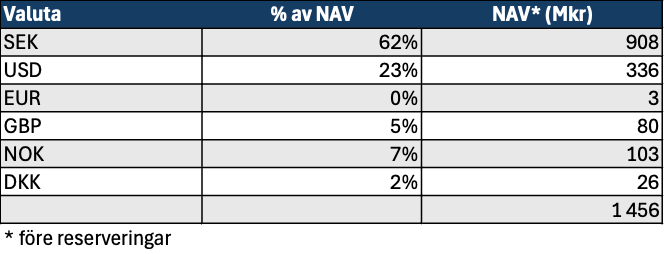
The Swedish krona strengthened during the month against the currencies in the portfolio except the Norwegian krone. However, the results of currency changes should be interpreted with caution. A large part of the fund's dollar exposure relates to holdings whose recoverable value is in practice determined by factors other than the dollar exchange rate. A few percent movement in the currency is therefore not what determines the fair value.
Loans and shares in the portfolio before reserves are distributed in underlying currencies as below.
The fund does not comment on individual holdings, ongoing sales processes or specific counterparties. The reasons are partly regulatory, as the fund is listed on NGM and is subject to the Market Abuse Regulation (MAR), and partly strategic. An open disclosure of the fund's position in ongoing negotiations could directly counteract the unitholders' common interest in maximizing recovered capital. For the same reason, this letter describes the portfolio's development at an overall level rather than individual assets.
No significant transactions were carried out during the month.
About refunds
The Fund seeks to repay capital to investors when possible without limiting the Manager's ability to act in the best interests of investors. In addition to the Fund's need to maintain a liquidity buffer, each repayment incurs costs. The Manager therefore continuously assesses whether the available liquidity in addition to the buffer is sufficient for a repayment to be economically justified and provide meaningful value to investors. The Manager does not commit to any predetermined timing for such repayments.
Changed information provision
The fund intends to update the document from 2024 that describes the process and management of the fund during the liquidation. A couple of years have passed since the decision to close and liquidate the fund. The nature of the fund's portfolio has changed during that time. There is therefore reason to update the principles and processes for the management of the fund.
The Fund also intends to review the appearance of the monthly reporting later in the year. As of the end of the month, there are no regular loans to external borrowers among the Fund's assets that have not deteriorated in credit quality according to the accounting rules in IFRS 9. The credits classified in category 1 are loans to companies that are indirectly controlled by the Fund. In category 2, there is only one loan to an external party. Otherwise, in this case too, they are loans to companies that the Fund indirectly controls.
The winding up of the Credit Fund has reached a point where the fund's portfolio no longer consists of ordinary credits that provide interest and amortisation. Instead, it consists of credits to bankrupt estates, bonds issued by companies that are now bankrupt estates, shares of various forms, listed and unlisted, claims on other companies in the group where pledges have been "parked" on behalf of the fund and where the value of the assets through the use of preference shares or loans with profit sharing accrues to the fund and thus to the fund unit holders. We have understood that many people find it difficult to understand from the accounts what the fund owns, and we therefore intend to try to find complementary ways to describe the portfolio without commenting on individual holdings.